
Author name: anilj

The Evolving World of Commercial Real Estate and Movements to Keep an Eye on in a Post-Covid World

As vaccines roll out across America, and day-to-day life begins to resume as usual, it is crucial to understand how Covid-19 has affected the commercial real estate industry. As we know, the pandemic shifted people’s perceptions on the necessity to work in an office every day or go to a physical store to purchase the goods they need. We saw a significant rise in work-from-home structures as well as a staggering 44% growth in e-commerce volume compared to the previous year (Forbes).

The new question: How has COVID impacted the market?

Our firm recently closed on a refinance of a newly constructed Class A multifamily property in South Florida. We reached out to several different lenders and like any debt assignment, once we sent out our loan request package we started to receive questions from the various lenders. We got the typical questions one would normally expect, “What concessions are being offered?”, “How many storage units are there?”, “Why is the insurance so high?” But the new question we had to address was “How has COVID impacted the market?”

What is driving the demand for Industrial real estate assets?

As we end the first quarter of 2021, the commercial real estate investing landscape is experiencing many changes. Entering the second quarter, everyone wants to know which asset classes will see quick recovery and which will continue to struggle in the post-Covid world. In the past 12 months, the pandemic has reshaped many industries. These shifts have demanded that investors adjust and have also expanded our ability to understand how external factors dramatically impact tenant and investor demand. In 2020 and into 2021, retail and office assets have faced challenges that no one ever predicted. These unprecedented circumstances have forced us to quickly adapt and underwrite assets in different ways to meet both tenant and investor needs driving creativity and innovation in the process. The pandemic has impacted economies around the world, tenant needs have shifted, and in turn, capital supply has changed as well.

Rents like an Apartment. Lives like a Home.

“The communities feature amenities that include swimming pools and parks. For consumers who want the whole house to themselves lifestyle without the mortgage, these little charmers are fitting the bill.”

The rental market is hot. Since the start of the Great Recession, the number of Americans living in rental properties has soared to nearly 37%, the largest amount since 1965. Over the same period, households lived in by owners are at an all-time low, according to Census Bureau data.

Hotel Financing Now Part 1: Navigating Hotel Financing Past the COVID Peak

As we look towards the future in hotel financing, it may be helpful to briefly reflect on the immediate past. As the hotel industry effectively shuttered at the end of March 2020, it also took away access to most hotel financing sources. The industry had a slow march towards recovering occupancy during the summer and fall only to face more headwinds in the Winter months. This occurred in response to dramatically rising COVID cases and the corresponding government restrictions on travel.

Is New York City Commercial Real Estate Dead in a Post COVID-19 World?

Many real estate professionals, writers and talking heads on television have recently been pontificating on  the death of New York City real estate due to COVID-19. The prevailing view point is that the virus has caused a fundamental shift in the way people live and work. The narrative portrays a bleak scenario where life in New York City is irreversibly changed and hordes of residents will permanently move to the suburbs or to other parts of the country and the work force will telecommute remotely.

Lever’s Angle from ICSC 2019

This year’s ICSC continued to accelerate trends that have been propagating for a few years now; new technologies, mixed use projects, and value-add acquisitions over ground up development. As usual we met with various people at the convention ranging from owners and developers to management companies and leasing agents.

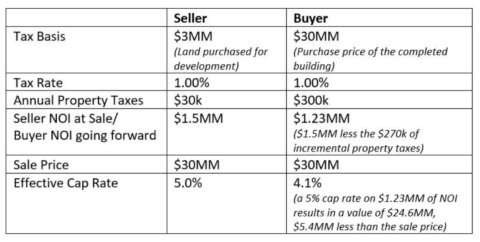
Tale Of Two Valuations: Buyer Vs. Seller Cap Rates

Development is hard, very hard. Just ask our clients. So is predicting what your project is worth after it is completed and what the returns will look like. Here is our take on how to best navigate modeling an exit, which has evolved from numerous conversations with our clients and equity partners.

Scroll to Top